Saturday, November 9, 2013

My Native American Warrior Series to Date

In addition to Native Americans, hardy Scots-Irish frontiersmen and women, colonial Englishmen and ladies, and even a few Frenchmen also play an important role in this series. So far, it spans the gamut from the dramatic era of the French and Indian War, through Pontiac's War, The American Revolution and shortly thereafter. But that time period may broaden as more stories are added to this line. I have a growing selection for you to consider. All lengths. A collection of historical romance featuring those Celts settled in the rugged Alleghenies and the Shenandoah Valley of Virginia, and the Native Americans they encountered.My Native American Warrior Series loosely ties together based more on time and place and strong Native American characters than as a traditional series that follows the storyline. However, Kira, Daughter of the Moon is the actual sequel to Through the Fire, and there will be other sequels. And stories.

Historical Romance Novel Redbird’s Song: (Inspired by events that occurred to my early American ancestors in the colonial frontier)
Blurb: Taken captive by a Shawnee war party wasn’t how Charity Edmondson hoped to escape an unwanted marriage. Nor did Shawnee warrior Wicomechee expect to find the treasure promised by his grandfather’s vision in the unpredictable red-headed girl.
George III’s English Red-Coats, unprincipled colonial militia, prejudice and jealousy are not the only enemies Charity and Wicomechee will face before they can hope for a peaceful life. The greatest obstacle to happiness is in their own hearts.As they struggle through bleak mountains and cold weather, facing wild nature and wilder men, Wicomechee and Charity must learn to trust each other. 
2012 EPIC Ebook Award Finalist
Cover by Rae Monet

“This is a beautifully written story filled with adventure and suspense…This book touched my soul even as it provided a thrilling fictional escape into a period of history I have always found fascinating.” –Night Owl Book Review by Laurie-J
“I loved the descriptions…I felt I was there…Many mystical episodes are intermingled with the events…The ending is a real surprise, but I will let you have the pleasure of reading it for yourself.”  –Seriously Reviewed
With Red Bird’s Song, Beth Trissel has painted an unforgettable portrait of a daring and defiant love brought to life in the wild and vivid era of Colonial America. Highly recommended for lovers of American history and romance lovers alike!~Virginia Campbell”I liked this book so much. The author has done a magnificent job of creating both characters and setting. The descriptions of the area are wonderful and put the reader right in there with the characters…I will most certainly read other books by this author.” Overall rating 5 out of 5 hearts Reviewer: Jaye Leyel for The Romance Studio
***Available in print and kindle at Amazon, in NookBook, and from other online booksellers
Kira, Daughter of the Moon~
"I have been a fan of Ms. Trissel's work for years. Kira, Daughter of the Moon completely lived up to every one of my expectations. I highly recommend this wonderfully written tale to anyone who loves historical romance." ~Five Stars from Poinsettia for Long and Short Reviews
‘A beautiful Scots-Irish healer in the rugged Alleghenies finds herself accused of witchcraft. With the terror of the French and Indian War fresh in her mind, can Kira love a white warrior?’
‘The Rugged Alleghenies, A White Warrior, Beautiful Scots-Irish Healer, Unrequited Love—Requited, Charges of Witchcraft, Vindictive Ghost, Lost Treasure, Murderous Thieves, Deadly Pursuit, Hangman’s Noose Waiting…Kira, Daughter of the Moon’
***Available in print and various ebook formats from The Wild Rose Press,  Amazon, Barnes & Noble in Nookbook, All Romance eBooks, and other online booksellers.
Set among the superstitious Scots in the rugged Alleghenies, the story is an adventurous romance with a blend of Celtic and Native American flavors. Although written to stand alone, Kira, Daughter of the Moon is the long-awaited sequel to my award-winning historical romance novel, Through the Fire.
Cover by Rae Monet~
 Blurb: Logan McCutcheon returns to colonial Virginia after seven years in the hands of Shawnee Indians. But was he really a captive, as everybody thinks? He looks and fights like a warrior, and seems eager to return to those he calls friends and family.
Kira McClure has waited for Logan all those years, passing herself off as odd to keep suitors at bay–and anyone else from getting too close. Now that he’s back, he seems to be the only person capable of protecting her from the advances of Josiah Campbell and accusations of witchcraft. And to defend the settlers against a well-organized band of murderous thieves.~
(Logan, the ‘white  warrior’ from Kira, Daughter of the Moon. One of my all time favorite heroes.)
Amazon Reader Review: 5.0 out of 5 stars
Another splendid historical!, October 25, 2012

This review is from: Kira, Daughter of the Moon (Paperback)

“Beth Trissel has written another thoughtful recreation of colonial times in this sequel to ‘Through The Fire’. Kira lives with relatives deep in the mountains of Virginia at a time when the English, French, and Native Americans are embroiled in constant skirmishes and out-and-out war. Logan was captured by the Indians seven years earlier and returns, now more Indian that white man, to retrieve a cache of gold left behind by others. Once he meets up with Kira, his childhood friend, sparks fly and he will have her for his own.
While following Kira and Logan’s personal battles we meet the best and worst of mankind. Evil and criminal forces threaten to keep them apart, and even kill them. Kira must learn to curb her tongue, hide her strange abilities and develop a strength she never dreamed she would be able to show. But is Logan worth the cost? Will he be true to her and give her a life she will be able to embrace? Can they ferret out the true villains and find peace and safety?
Miss Trissel’s lush descriptions of the rugged mountains, the harsh living conditions, and the uncertain times give life to what our forefathers endured to build a land we now call America. The characters, rugged Scot-Irish men and women, soldiers, Indians, and engaging children, come alive in this romantic adventure of life and love on the frontier.”
Native American Historical Romance Novel Through the Fire:
Through the Fire cover Final4“The storyline of Through the Fire is well-written and uncommonly descriptive. Ms. Trissel took great time and effort to research Indian beliefs and their way of life. Anyone who buys this book will take great pleasure in it.” ~You Gotta Read by Laura
“Through the Fire is full of interesting characters, beautifully described scenery, and vivid action sequences. It is a must read for any fan of historical romance.” ~Long and Short Reviews by Poinsettia
2008 Golden Heart® Finalist
Blurb for Through the Fire:
Will love inflame these two natural-born enemies in fiery destruction?
Passions run deep in the raging battle to possess a continent, its wealth and furs. Both the French and English count powerful Indian tribes as their allies. English lady Rebecca Elliot, having eloped to America with a British captain, finds herself a widow. When she ventures into the colonial frontier with the militia to seek her uncle, she unwittingly enters a dangerous world of rugged mountains, wild animals, and even wilder men. The rules are different here and she doesn’t know them, especially those of the savagely handsome warrior who captures her body and her heart.
Red-Tailed HawkHalf-Shawnee, half-French warrior Shoka, former guide for English traders, is the hawk, swift, sure, and silent as the moon. He knows all about survival in this untamed land and how deadly distraction can be. His intent is to sell Rebecca to the French before she draws him under her spell, but if he lets her go he can no longer protect her. If he holds onto her, can he safeguard his heart? With battle looming and an enemy warrior bent on vengeance, Shoka and Rebecca must decide whether to fight together or be destroyed.
The French and Indian War, A Shawnee Warrior, An English Lady, Blood Vengeance, Deadly Pursuit, Primal, Powerful, Passionate…Through the Fire.
Shoka and Rebecca (2)Excerpt:
For a moment, he simply looked at her. What lay behind those penetrating eyes?
He held out the cup. “Drink this.”
Did he mean to help her? She’d heard hideous stories of warriors’ brutality, but also occasionally of their mercy. She tried to sit, moaning at the effect this movement had on her aching body. She sank back down.
He slid a corded arm beneath her shoulders and gently raised her head. “Now try.”
Encouraged by his aid, she sipped from the wooden vessel, grimacing at the bitterness. The vile taste permeated her mouth. Weren’t deadly herbs acrid? Was he feigning assistance to trick her into downing a fatal brew?
She eyed him accusingly. “’Tis poison.”
He arched one black brow. “No. It’s good medicine. Will make your pain less.”
campfireUnconvinced, she clamped her mouth together. She couldn’t prevent him from forcing it down her throat, but she refused to participate in her own demise.
“I will drink. See?” Raising the cup, he took a swallow.
She parted her lips just wide enough to argue. “It may take more than a mouthful to kill.”
His narrowing eyes regarded her in disbelief. “You dare much.”
Though she knew he felt her tremble, she met his piercing gaze. If he were testing her, she wouldn’t waver.
His sharp expression softened. “Yet, you have courage.”~
***Through the Fire is in kindle at Amazon
Cover by my daughter Elise Trissel
A Handsome frontiersman, Mysterious Scots-Irish Woman, Bearwalking Shawnee Warrior, Dark Secret, Pulsing Romance…The Bearwalker’s Daughter
~The strange awareness inside Karin grew, like a summons urging her to an untamed place. His gaze drew her almost against her will. She leaned toward him.
“Someone seeks you, Shequenor’s dahnaithah.”
The message rippled through her. And she knew—his was the inviting summons in the wind.~
Karin McNeal hasn’t grasped who she really is or her fierce birthright. A tragic secret from the past haunts the young Scots-Irish woman longing to learn more of her mother’s death and the mysterious father no one will name. The elusive voices she hears in the wind hint at the dramatic changes soon to unfold in the mist-shrouded Alleghenies in Autumn, 1784.
Jack McCray, the wounded stranger who staggers through the door on the eve of her twentieth birthday and anniversary of her mother’s death, holds the key to unlock the past. Will Karin let this handsome frontiersman lead her to the truth and into his arms, or seek the shelter of her fiercely possessive kinsmen? Is it only her imagination or does someone, or something, wait beyond the brooding ridges—for her?
(A revised version of Daughter of the Wind)
“Ms. Trissel’s alluring style of writing invites the reader into a world of fantasy and makes it so believable it is spellbinding.” -Long and Short Reviews
“I loved the plot of this story, oh, and the setting was wonderful.”-Mistress Bella Reviews
“I found this book fascinating.” -Bitten By Books
***Available at Amazon in Kindle 
Cover by my daughter Elise Trissel
Blurb for The Lady and the Warrior:
An abused young wife stranded in the Alleghenies in 1783 is rescued from drowning by a rugged frontiersman who shows her kindness and passion. But is he more than he seems? And can they ever be together?
About The Lady and the Warrior:
A short historical romance story with a The Last of the Mohican’s flavor to give readers a taste of my full-length American historical romance novels.  If you like The Lady and the Warrior, chances are you will enjoy Red Bird’s Song and Through the Fire, and Kira, Daughter of the Moon.  All have a strong Native American theme interwoven with the plot.
***Available at Amazon Kindle for .99
Amazon Reader Review:
5.0 out of 5 stars Really good romance, March 24, 2012
Amazon Verified Purchase
This review is from: The Lady and the Warrior (Kindle Edition)
“I’ve read a few other books written by Beth Trissel so decided to give this one a shot. Really glad I did. I’m in love with this story. It was incredibly touching. A true romance. This author has a way of pulling on your heartstrings. Yep, I got a little emotional. If you’re looking to read something memorable, this tale is for you!”
Cover by my daughter Elise Trissel
Author Awards:
2008 Golden Heart® Finalist
2008 Winner Preditor’s & Editor’s Readers Poll
Publisher’s Weekly BHB Reader’s Choice Best Books of 2009
2010 Best Romance Novel List at Buzzle
Five Time Book of the Week Winner at LASR
2012 Double Epic eBook Award Final
2012 Reader’s Favorite Finalist

Friday, November 8, 2013

'A Very Virginia Christmas Stories and Traditions'--Charming Holiday Book!

A Very Virginia Christmas: Stories and Traditions (2012 Independent Publishers Gold Medalist) by Wilford Kale debuted last November at the Barnes & Noble in Colonial Williamsburg. I was among the authors who took part in the auspicious signing. Why, you may ask?

Because I'm delighted to have an account from my nonfiction book, Shenandoah Watercolors, included in A Very Virginia Christmas. My holiday excerpt in this wonderful collection describes celebrating Christmas at the old Family home place in the Shenandoah Valley. I'm honored to be among the illustrious authors who span centuries of life in my beloved Virginia, and proud to add my voice to the holiday reminiscences from our beautiful valley. If you haven't gotten your copy yet, you're missing out, and it's getting to be that time of year again. The book would make an excellent Christmas gift. A Very Virginia Christmas is available in hardcover at Amazon and from many other booksellers. 
The publisher of this lovely Christmas Collection, Parke Press, has this to say about A Very Virginia Christmas: 
"For the past 400 years, Virginians have created traditions of their own, borrowing from a variety of Christmas celebrations in other countries. This year, Wilford Kale has compiled the work of 16 contributors telling how Virginians observe the Christian wintertime holiday: from the Shenandoah Valley to the Eastern Shore, from colonial days up to the 21st century, in times of need to times of feasting and merriment. Read about eggnog, Robert E. Lee's Christmas, Parke Rouse's Christmas on the Southside, Richmond's Nativity pageant, and Earl Hamner's childhood Christmas in the Virginia mountains. You will also find stories including the Christmas Truce, the origin of "Jingle Bells" and "Rudolph," along with other Christmas favorites. Your storytelling time at Christmas will be warmer and cozier than ever with these tales that remind all ages of the real meaning of  "the most wonderful time of the year."
An article in the Virginia Gazette gives even more insights to this vintage Christmas collection and the special man behind it, Wilford Kale. Entitled A Jolly Collection of Virginia Christmases, the article goes on to say: "Who better to compile a book about Christmas in Virginia than a man who could pass for Santa Claus.
Wilford Kale, a long-time journalist, short-term politician and part-time Kris Kringle, has edited "A Very Virginia Christmas – Stories and Traditions," a new collection of stories, anecdotes and traditions about Christmas. He's included the work of some heavy hitters, including Earl Hamner of "The Waltons" fame, Booker T. Washington, Park Rouse and Francis Church. Oh, Henry Wadsworth Longfellow and Alfred Tennyson are included too.
The collection includes four centuries of Christmas memories and anecdotes, ranging from Capt. John Smith to the generations of children who visited perhaps the state's best-known Santa at Miller & Rhoads in Richmond."
To that I add, and me! For the complete article, I recommend you visit the link. And God Bless us Everyone!

***Images of the old family home place outside of Staunton, Virginia, a wreath in Colonial Williamsburg, and a Victorian Santa Claus (royalty free)
.

Wednesday, November 6, 2013

Sayings and Superstitions From the Shenandoah Valley


(The Shenandoah Valley of Virginia by my mother Pat Churchman)

These sayings are taken from Shenandoah Voices:  Folklore, Legends, and Traditions of the Valley by late historian and author John Heatwole. I also threw in some cures. Images of the Shenandoah Valley and Mountains were taken by my talented family.

I knew and greatly respected John Heatwole.  He even helped me with some of the initial research for my first historical novels. The wealth of knowledge he amassed is just one of the rich legacies John left behind.
Shenandoah Voices is my favorite book by him.  I recommend it to anyone interested in the old ways and days of rural Virginia, especially the valley and surrounding mountains. I was also privileged to hear John speak on this fascinating subject. He’s best known for his vast knowledge and books about the Civil War. He was also an amazing wood carver/artist, a man of many talents.  Much missed.

(Image of log hog/chicken barn by my husband Dennis.)
****

Many early valley settlers were Scots-Irish, my ancestors among them.  People from the British Isles tended to be superstitious.  Also prevalent in the valley were Germans bringing the influence of the Pennsylvania-Dutch, another superstitious group.  To quote Michael Scott, boss from NBC’s hit show, The Office, “I’m not superstitious, just a little stitious.”

****
It’s bad luck to lay a hat on the bed.~

An itching nose means a visitor is coming. ~

A cardinal bumping against the window pane is an indication of an early death~

*To this I have to add ‘or an insanely jealous bird regarding his reflection as another male which tends to happen with cardinals.’

Peel an apple all in one piece and throw the peel over your shoulder.  When you turn around and look at it lying on the ground, whatever letter it reminds you of will be the first letter of your future husband’s last name.~ (This is an ancient Celtic Custom)

It’s bad luck to point at a rainbow. ~ *I suspect we are all guilty of this one.  Who knew?

It’s bad luck to bring a shovel into the house ‘because it is a grave tool.’ Some also think a hoe in the house bodes no good.~ (Image of old smokehouse from the outside and from the inside below. The smokehouse is at our favorite Christmas tree farm outside the tiny hamlet of Singers Glen. Images by daughter Elise.)

If you enter a house and leave it without sitting down it is bad luck.  Particularly if you leave by a different door than the one you entered.~

If a bird flies into your house there will soon be a death in the family~Within six months if a whippoorwill comes to your treetop and sings at night. ~ *How many of you have even heard a whippoorwill?  I have.

If a baby smiles in its sleep, the child is talking to the angels. ~ *My personal favorite.
Rain isn’t far behind when a tree shows the underside of its leaves.~
Count the number of foggy mornings in August and that is how many winter snows there will be.~ I heard this one not long ago and suspect it may be true.  I’m also a believer in wooley bears predicting winter…
A new moon with the points up means dry weather, and a moon with the points down means rain will soon fall. ~
If a full moon has a ring around it there will be snow by morning. ~ If the ring is large, the number of stars you count in it will be the number of inches that fall.~ *We say a ring around the moon means rain, or snow, within a few days.
(Creepy old barn up behind our house taken by Daughter Elise.)
Sheep shearing takes place around the first of May.  A cold rain will follow within a few days of shearing called a sheep rain. ~
On Ash Wednesday people made pancakes or the chickens wouldn’t lay.~ *We still have pancake suppers in the valley on that day.
Horse chestnuts carried in the pocket are thought to ward off rheumatism. ~
Sassafras tea is good to thin the blood. ~
Broth made from the hind legs of mice is good for kidney ailments.~ *Not tried this one. ‘Swamp root’ tea is also recommended for kidney disorders.~ I’ll have to research exactly what swamp root is.
(The Alleghenies by my mother)
For someone who is weak and recovering from long illness, make them sparrow broth tea. ~ *This supposedly saved my grandmother’s life when she was sick as a child.
Before taking a new baby out for its first ride (this probably applied to a wagon or buggy) the ‘herb lady’ rubbed warm bear grease on one of the infant’s palms and the bottom of the opposite foot thus insuring that the baby was protected from the rigors of the journey.
A hog’s tooth carried in your right pocket will ward off toothache.~ *Maybe I should take up this one.

Catnip tea was made for children with colic.~ Tea from peppermint leaves will stop a stomachache.~ *These are still practiced.
Sage tea will keep a woman’s hair from turning gray prematurely.~
(old bridge in the valley, bordering the Alleghenies by my husband)
Treat measles with sheep manure that has been boiled, strained, and diluted with moonshine.~ *I assume with enough moonshine the patient didn’t notice the manure so much.
For a bad cold put lard on your chest sprinkled with salt. Another remedy is a mustard plaster made with mustard, lard, and egg whites and laid on the chest~
Freckles on the face can be washed away on the first of May. If they are washed in morning dew, they will be transferred to the hands which can be dried on another less visible part of the body like the arms or legs and left there permanently.  It’s recommended that this practice be repeated for three years in a row to work. ~

Quite an investment in time.
(Image of river in the mist by my mother)
When mumps invade your house put hog manure on the throat as a relief or cure. ~ *Considering the stench of hog manure, I doubt the sufferer would find much relief.
To get rid of warts, tie a knot in a string for each wart you have and bury it under rock.  When the string rots the wart will be gone. ~


                                 (Old house in the Blue Ridge Mountains by my husband)
If you are sitting up with an ill person and a spark flies from the fireplace in the room, it is a sign of impending death. (From Hardy County, West Virginia).
It would be a terrible mistake for you to kill a lightning bug because lightning might kill you during the next electrical storm. (From Wise County, Virginia)
In the Blue Ridge Mountains it was believed that if a glass fell from a table after midnight and rolled across the floor, a coffin would have to be made the next day.
And I could go on, but this is enough for now.  Well, maybe one more.
When springtime rolls around again, and if you are fortunate enough to make a wish on the first toad you see hopping by, you will have abundant good luck. (From Wise County)
(The Alleghenies by my husband)

Tuesday, November 5, 2013

The Curative Power of Blackberries and Raspberry Cordial


Blackberry bushI love raspberries and blackberries, and grow red raspberries in the garden among my bounding mint patch. The berries only recently succumbed to hard frost, but were producing right up until it hit. My dear grandmother grew red raspberries and this variety is much like hers. I did a little digging and discovered more about the bramble family. Raspberries and blackberries are native to North America. Some kinds are thorny, others thornless, and there’s a wide variation in taste and color. They thrive in all 50 states and Canada.
From Field Guide to Wild Plants by Bradford Angier, a wonderfully informative book given to me by my grandmother years ago. Mr. Angier has also written many other volumes. (This Amazon link takes you to the second edition of his book, I have the first).
“Juice and wine made from the berries is still used in Appalachia to combat diarrhea. The berries and their juice were long used by many Indian tribes to rid their members of chronic stomach trouble and to allay vomiting. It was considered effective in preventing miscarriage. It is astringent and believed generally beneficial to digestion, being thought mild enough to control diarrhea and dysentery even among infants and children. Early Americans sometimes combined it with honey and alum to tighten loose teeth. The settlers also came to use the juice to dissolve tartar on the teeth. It was turned to by numerous tribes to cure cankers of the mouth and gums.
Blackberry blossomsThe juice was also turned to by many Indians and pioneers to lessen menstrual flow without suddenly ending it entirely. When the bowels were loose it was drunk instead of tea or coffee. It was thought to ease nausea, be an antacid, and act as a parturient (aids in birth). Many a colonial deemed his medicine chest incomplete if it did not contain blackberry brandy or cordial.”
This is how strongly they believed in its curative and stomach soothing properties, which I can also vouch for. Blackberry leaves were gathered after the dew was off them, dried at room temperature, not in the sun, and stored in tightly capped jars in dark cupboards. A level teaspoon of the dried leaves were steeped in a boiling cup of water, then drunk cold, 2 cups a day, as a tonic or blood purifier. It was thought helpful to give to mothers in childbirth and during delivery. A potent tea was applied to sores and used as a gargle and mouthwash. Strong healing teas were also made from the blackberry roots and bark (steeped fresh, or from the dried bark/roots) as a tonic, for treating diarrhea, upset stomachs, whooping cough, labor pains…
An old standby from the McNess Company is great for soothing troubled digestion. McNess salesmen used to go door to door, and we had a kind elderly gentleman, but they no longer do. It’s called Aromatic Compound and is a liquid medicinal blend made from extracts of blackberry, rhubarb, and ginger with anise and clove oil. If you’re interested in getting a bottle, visit the link to their site.
Anne of Green GablesAnne of Green Gables fans will remember the scene (I watched the series) where Anne is delighted to host a tea party for her friend Diana. She’s particularly proud to serve a special bottle of Marilla’s raspberry cordial, but mistakenly offers Diana currant wine, not meant to be imbibed by the tumbler full (3 of them) as it’s alcoholic. The inevitable happens and causes much distress, which is eventually overcome. Those of you interested in making raspberry cordial, and/or catching up on Anne of Green Gables, will enjoy visiting this blog post:http://thehistorykitchen.com/2012/07/20/anne-of-green-gables-raspberry-cordial/

Monday, November 4, 2013

Sage in America and the Native American Smudging Ceremony

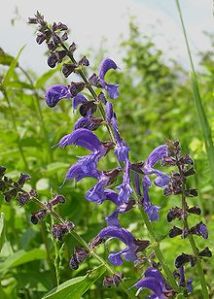
Sage is a lovely and important medicinal herb, also a sacred one. I grow several varieties and am always adding more. My garden is never without the traditional garden sage, salvia officinalis. There are some variations of this kind, the fuzzy leafed and tricolored sage, but I still like the good old standby that came to America with the early colonists. You may not realize how many varieties of sage are native to the New World, and their many uses, medical and spiritual. Scarlet sage attracts hummingbirds and is striking in the border, but there are many beautiful varieties. 
Sage (Salvia) Common name: Wild Sage, Meadow Sage (S. pratensis) Scarlet Sage or Texas Sage (Salvia coccinea), Chia Sage grows throughout southern Canada and the United States, the very important chia (S. columbriae) in Arizona, Utah, Nevada, and California.
Meadow Sage
From Field Guide to Medicinal Wild Plants by Bradford Angier:

I love this book, given to me by my dear grandmother who lived to be 99 and a half. Mr. Angier has also written other volumes.
Sage is a fuzzy perennial with soft, downy hairs. One characteristic is that, when a bunch is wadded together, it clings to itself, remaining a compact mass. The erect stems are greyish with down and have, on pubescent stalks toward their bases, up to about 18-inch-long leaves. 
Several wheels of tiny blue or whitish, and sometimes reddish, flowers grow in whorls of four to eight, depending on the particular species. The plants have an easily recognized strong, unique, aromatic odor.
Chia  Sage (S. columbriae)The chia variety, a distinctive annual springing up in the Southwest at the start of the late fall rains and an Indian standby, is a rough sage with deeply incised, coarse, usually hairy, dark-green leaves that grow mostly close to the ground. Three or so whirls of small blue flowers circle, mint like, in separated densities above prickly, dark-red, leafy bracts. These mature into seed-filled pods that remain like skeletons when the rest of the plant has withered, not giving the winds enough purchase to blow them free, and leaving them for the Indians to gather.
The seeds of the Texas sage (S. coccinea) are oblong, angular, or bowed, and 2 to 3 millimeters in size. Those of the annual scarlet sage take two or three weeks to emerge.
Scarlet Sage, Salvia coccineaThe medicinal part of the plant in general is the leaves, harvested during the flowering period in June and July. In the case of the chia, the vital part is the seeds, which are gathered from the then nearly dead annual in July.
Steeped like tea and in the same proportions, sage tea was slightly tonic and quieting to a disordered stomach. It’s peculiar but pleasant odor was retained in the beverage by the warmish, somewhat bitter aroma of the extracted volatile oil. It was said to benefit a ticklish and irritated throat, to quiet and expel bothersome gas, and assist the liver, kidneys, and gallbladder. Regarded in many regions as effective in treating sore throat, accompanied by fever, cankers, sore gums, mouth ulcers, and swollen tonsils, and as an effective gargle. The juice from bruised fresh leaves was credited with helping to remove warts, also pressed into service for sores, cuts, and wounds. The Indians made a salve of the crushed fresh leaves and edible lard for these purposes. Some tribes made salve from the roots of wild sage (S. lyrata).
A refreshing drink for hot weather was made by mixing chia seeds with cool water, each seed becoming separately suspended in its own white, mucilaginous cloudiness. The white, gray, and brown seeds are so nutritious that a teaspoonful was regarded as enough to sustain an Indian for a day on a forced journey.
JosephHenry Sharp-Making Sweet Grass Medicine - Blackfoot CeremonyNative American Smudging Ceremony: From The Smudging Ceremony
"Our Native elders have taught us that before a person can be healed or heal another, one must be cleansed of any bad feelings, negative thoughts, bad spirits or negative energy - cleansed both physically and spiritually.,,Native people throughout the world use herbs to accomplish this. One common ceremony is to burn certain herbs, take the smoke in one's hands and rub or brush it over the body. Today this is commonly called "smudging." In Western North America the three plants most frequently used in smudging are sage, cedar, and sweetgrass.
Many varieties of sage have been used in smudging. The botanical name for "true" sage is Salvia (e.g. Salvia officinalis, Garden Sage, or Salvia apiana, White Sage). It is interesting to note that Salvia comes from the Latin root salvare, which means "to heal." There are also varieties of sage which are of a species separate from Salvin Artemusia. Included here are sagebrush (e.g. Artemisia californica) and mugwort (Artemisia vulgaris). We have seen both Salvia and Artemisia sub-species used in smudging."
I've discussed salvia officinalis (pictured below) in another post, but briefly: Salvia officinalis (called garden or common sage) is a perennial, evergreen subshrub, with woody stems, grayish leaves, and blue to purplish flowers. A member of the family Lamiaceae, sage is native to the Mediterranean region, though it has naturalized in many places throughout the world.
"Native Americans consider sage, cedar, sweetgrass and tobacco as the Four Sacred Herbs. Sage is found across North America, with white sage being the most potent and gray sage found in many northern areas where the gray will not over-winter. Cedar (Eastern red cedar) (Eastern white cedar) and sweetgrass also are indigenous to this continent. Tobacco can be found in many forms; however for this ceremony Nicotiana Rustica, or a similar dried tobacco leaf, native to America is preferred."