Showing posts with label herbal medicine. Show all posts

Tuesday, October 11, 2016

Don't Overlook Mullein--Herbal Medicine

Verbascum_densiflorum_'dense-flowered_mullein'
Mullein: In Scotland (Aaron’s rod, shepherd’s club, donkey’s ears, cuddy-lugs, Rox) In North America (Indian tobacco, among many other names)
Mullein grows wild in Virginia and most everywhere else in America. I like mullein, a stately plant. The leaves are soft and fuzzy, and the flower heads impressive. Granted, it’s weedy and I don’t want it to take over, but it’s among my favorite weeds. A key herb in America, mullein is mentioned, but without nearly as much emphasis, in Scotland. Apparently, the Indians better mastered its medicinal uses, however, they are similar to those in the UK.
Perhaps because the plant is widely distributed in America, it was more greatly appreciated. The Indians smoked the dried leaves or made a smudge of them over the coals of a dying campfire and inhaled the medicinal smoke for treatment of asthma and lung conditions. The fumes were used to revive an unconscious patient. Mullein was used to ease coughs. An ounce of dried leaves were simmered in water or milk for ten minutes, strained, sweetened with honey or maple sugar, and the infusion sipped warm. This was also considered useful for diarrhea.
I've read of mullein leaves placed inside moccasins to sooth sore feet. The dried flowers were soaked in edible oil for several weeks, and the oil then used externally for earaches, piles, sunburn, rashes, inflammation, and internally for coughs, lung and chest trouble. Mullein oil was considered effective against disease germs and a natural antibiotic.

Thursday, October 6, 2016

Herbal Lore–Boneset (Not actually used to set bones)

boneset
Boneset (Ague-weed) is a beautiful native American plant found in moist meadows, woodlands, along stream banks, or in swamps across Eastern North America and west to Louisiana and Minnesota.  A member of the aster family, it blooms July--September with flat clusters of white flowers. Once established, boneset resembles a small shrub at 3’ to 4’ tall. The base of the leaves appear to wrap around the stem, as if pierced by the stem. This perforated arrangement of the leaf and stem led to the species name E. perfoliatum. Because the leaves are wrapped around the stem, early herbalists concluded the plant would be useful as a plaster, along with bandages, for setting broken bones.
Boneset was also infused as a tea to treat fevers, colds, and digestive ailments. A Modern Herbal suggests the name boneset rose from its use as a treatment for Dengue fever, also known as Break Bone Fever, and declares, ‘Probably no plant in American domestic practice has had more extensive and frequent use.’ The summer flowers attract pollinating insects, such as butterflies. In the fall, the seeds draw a variety of songbirds.
“Boneset was one of early America's foremost medical plants, a popular panacea of extraordinary powers. Native Americans introduced the settlers to this New World herb. Its name reflects its use during a particularly harsh strain of flu called "break bone fever". Come cold and flu season, boneset can be invaluable in relieving coughs and upper respiratory congestion. Today, it is chiefly regarded as a weed with an interesting past.”
“In West Virginia folk medicine, boneset was simmered with lemon and honey to make a cough syrup. The Eclectic physicians used it with success during the influenza epidemic of 1918-19. In modern herbalism, it is usually combined with elder and willow for fevers with aches, and with scullcap and milkweed for flu.”
That's pretty darned amazing because that was a killer flu.

Monday, October 3, 2016

Herbal Lore and the Wonder of Old-Time Plants

Natural fresh herbs
Simple wayside flowers, even weeds, have a far greater heritage than most people realize. We modern folk cannot begin to grasp the enormous part that herbs--‘a plant or plant part valued for its medicinal, savory, or aromatic qualities'--played in every aspect of life in times past; the not so distant past. There were no drugstores to run to for health and beauty aids, no cures to be had at every corner. Remedies for everything from colds to the bubonic plague were made into tinctures, teas, salves, poultices..
A Modern Herbal by Mrs. M. Grieve, first published in 1931, allots six pages to dandelions alone. The yellow flowers of this much maligned weed, so loved by children, supply rich nectar for the bees and wine for man. The tender spring leaves are vitamin rich and eaten fresh, or dried for digestive drinks and herbal beer. The roots are roasted for dandelion coffee, said to be indistinguishable from real coffee, though I suspect I would detect the difference. The entire plant is esteemed as a tonic, especially good for the liver and kidneys. This just scratches the surface of the wonders of dandelion.
Burdock is a marvel in its own right. The leaves and seeds are infused to treat skin disorders, including eczema, and are taken as a remedy for nervous hysteria, an interesting combination and certainly useful. Lovesick? Pansies, also known as heartsease, were highly valued for their potency in love-charms and played an important part in Midsummer Night’s Dream.
“There’s rosemary, that’s for remembrance…and there is pansies, that’s for thoughts.” ~ William Shakespeare

Friday, November 7, 2014

The Wonder of Sassafras


sassafras leaf in autumnIn need of a tonic? Sassafras comes to mind and figures prominently in my colonial American historical romances set in the Alleghenies among the Native Americans. Think the colonial frontier–The Last of the Mohicans–and you’re there.
Back to sassafras. I love the tree’s varied mitten shaped leaves and its distinctive, aromatic scent. My parents have a sassafras tree growing in their yard, but I’d have to head into the mountains to get my fix, or buy sassafras from the small local grocery store.
*Note to self, plant sassafras trees. Maybe if I put in an entire grove some would survive. Our challenge is the cows which occupy much of our land and eat anything not protected behind secure fencing. Saplings are among their favorite delicacies.
You might be interested to learn, as was I, that Christopher Columbus is said to have quelled mutinous seamen by the sudden sweet smell of sassafras which indicated the nearness of land. Not only did it aid in the discovery of the New World, but was an important export to Europe in the early days of colonial American, even exceeding shipments of tobacco.
Wine made from the darkly blue berries has been imbibed for colds. During the spring-flowering period, the blossoms were simmered to make a tea for reducing fevers. A blood purifying spring tonic was and still is imbibed from a tea made by brewing the roots. A tea distilled from the bark was believed to aid in the treatment of bronchitis, respiratory ailments and tummy upset. Chewing the bark was thought to help break the tobacco habit, a problem even in the early days of this country. The roots were distilled and the oil from them used to flavor many products including ginger ale, sarsaparilla, cream soda, root beer, toothpaste…
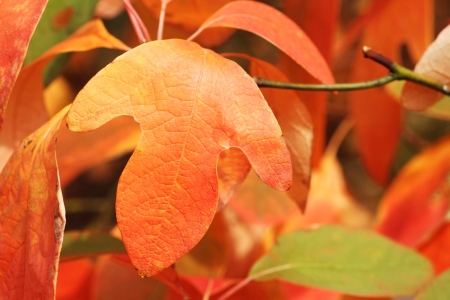
Sassafras leaves in autumn
A poultice made from the leaves and laid on wounds was used to stop bleeding and aid in healing. Native Americans steeped in the many uses of sassafras passed their knowledge along to European settlers in the colonial frontier. A tea from the bark was also thought to be beneficial in the treatment of venereal disease, needed by both Indians and colonists alike. If you wonder what ailments afflicted folk in the early days of this country, you need only read what they were most interested in finding treatments for and cancer doesn’t make the top ten.
How to make sassafras tea: One method is to vigorously scrub several roots, a couple of inches long, and use the whole root, or cut them in into pieces, and bring to a boil in three pints of water. Reduce heat and simmer for fifteen minutes. Remove from heat, cover, and steep for another ten minutes before straining and serving. Yet another method is to drop several roots into a quart of boiling water, remove from heat and steep then serve. A pound of roots will make 4 quarts of tea and can be used several times before they lose their strength.
For the bark, especially used as a spring tonic, cut or grind a teaspoon of bark and steep in a cup of boiling water for ten minutes, strain and sip. The tea from either root or bark should have a yellowish red hue, rich smell and pleasing taste. It can be thinned with milk or cream and sweetened. I would add some honey, but those of you who like it plain, enjoy.
And good health to us all.

Tuesday, November 5, 2013

The Curative Power of Blackberries and Raspberry Cordial


Blackberry bushI love raspberries and blackberries, and grow red raspberries in the garden among my bounding mint patch. The berries only recently succumbed to hard frost, but were producing right up until it hit. My dear grandmother grew red raspberries and this variety is much like hers. I did a little digging and discovered more about the bramble family. Raspberries and blackberries are native to North America. Some kinds are thorny, others thornless, and there’s a wide variation in taste and color. They thrive in all 50 states and Canada.
From Field Guide to Wild Plants by Bradford Angier, a wonderfully informative book given to me by my grandmother years ago. Mr. Angier has also written many other volumes. (This Amazon link takes you to the second edition of his book, I have the first).
“Juice and wine made from the berries is still used in Appalachia to combat diarrhea. The berries and their juice were long used by many Indian tribes to rid their members of chronic stomach trouble and to allay vomiting. It was considered effective in preventing miscarriage. It is astringent and believed generally beneficial to digestion, being thought mild enough to control diarrhea and dysentery even among infants and children. Early Americans sometimes combined it with honey and alum to tighten loose teeth. The settlers also came to use the juice to dissolve tartar on the teeth. It was turned to by numerous tribes to cure cankers of the mouth and gums.
Blackberry blossomsThe juice was also turned to by many Indians and pioneers to lessen menstrual flow without suddenly ending it entirely. When the bowels were loose it was drunk instead of tea or coffee. It was thought to ease nausea, be an antacid, and act as a parturient (aids in birth). Many a colonial deemed his medicine chest incomplete if it did not contain blackberry brandy or cordial.”
This is how strongly they believed in its curative and stomach soothing properties, which I can also vouch for. Blackberry leaves were gathered after the dew was off them, dried at room temperature, not in the sun, and stored in tightly capped jars in dark cupboards. A level teaspoon of the dried leaves were steeped in a boiling cup of water, then drunk cold, 2 cups a day, as a tonic or blood purifier. It was thought helpful to give to mothers in childbirth and during delivery. A potent tea was applied to sores and used as a gargle and mouthwash. Strong healing teas were also made from the blackberry roots and bark (steeped fresh, or from the dried bark/roots) as a tonic, for treating diarrhea, upset stomachs, whooping cough, labor pains…
An old standby from the McNess Company is great for soothing troubled digestion. McNess salesmen used to go door to door, and we had a kind elderly gentleman, but they no longer do. It’s called Aromatic Compound and is a liquid medicinal blend made from extracts of blackberry, rhubarb, and ginger with anise and clove oil. If you’re interested in getting a bottle, visit the link to their site.
Anne of Green GablesAnne of Green Gables fans will remember the scene (I watched the series) where Anne is delighted to host a tea party for her friend Diana. She’s particularly proud to serve a special bottle of Marilla’s raspberry cordial, but mistakenly offers Diana currant wine, not meant to be imbibed by the tumbler full (3 of them) as it’s alcoholic. The inevitable happens and causes much distress, which is eventually overcome. Those of you interested in making raspberry cordial, and/or catching up on Anne of Green Gables, will enjoy visiting this blog post:http://thehistorykitchen.com/2012/07/20/anne-of-green-gables-raspberry-cordial/

Thursday, January 19, 2012

Medieval Medicine--Old Scottish Hospital Unearthed


Somewhere My Lass
 is a unique suspenseful Scottish time travel romance that opens in a Victorian home in historic Staunton, Virginia before taking the leap back to the Highlands. While doing research for the story I uncovered a wealth of information about various time periods and the many facets that go along with a particular setting.  One fascinating archeological discovery I came across is the ancient hospital run by monks at Soutra, high in the Lammermuir Hills, near Edinburgh. This Medieval hospital was dedicated to looking after the poor, travelers, and pilgrims as well as the sick and infirm. Ancient Scotland did a lot more with medicines than I realized.  At least, the Medieval monks did.  I assume they shared this knowledge with other healers.
To quote from the above site: “Evidence…suggests the medieval Augustine monks also knew how to amputate limbs, fashion surgical instruments, induce birth, stop scurvy and even create hangover cures. The excavations at Soutra have also unearthed fragments of pottery vessels that were once used for storing medicines such as an analgesic salve made from opium and grease and treatment for parasitic and intestinal worms. Dressings have also been found, some still with salves or human tissues attached and the scientists have discovered a mixture of Quicklime (calcium oxide) which scientists believe was used as a disinfectant and a deodorant.”
“Dr Brian Moffat archeo-ethno-pharmocologist and director of investigations for the Soutra Project, studies clumps of seeds from the site. He said the scientists trawl literature of the period to try and identify remedies the herbs could have been used to create. They then search the site to find medical waste evidence to support their theories…”
I thought all of this was fascinating.
*The pic is all that’s left of Soutra now.