Showing posts with label herbal. Show all posts

Tuesday, June 28, 2016

I like gardening — it's a place where I find myself when I need to lose myself. — Alice Sebold


After a hard winter, and vexing spring, June has been a joy to the senses. Such a delight to dash outside any time the pure gold light beckons. I never know what I'll find to photograph, a new hobby for me. I'm using my cell phone, haven't advanced to an actual camera yet. The garden is alive with butterflies, bees, bumbles, birds, and fireflies (tough to capture pics of those tantalizing glimmers) in addition to the plants. Extra time in the garden is good for the spirit, so I'm out the door the instant it summons. 

The double apricot hollyhocks I photographed below are blooming on the only plant that survived the winter from the many seedlings I started last spring and nurtured all summer. Endless watering during the long dry spell...and all gone, but this one remaining hollyhock is glorious. I will save seed from it and try again for more.


The poppies are exquisite, like butterflies fluttering in the breeze...their silken petals fabric for sumptuous gowns. If such whimsy were possible. Maybe for the fairies. The pollinators also love poppies. 

"One of the most delightful things about a garden is the anticipation it provides." ~W.E. Johns, The Passing Show


(Breadseed Poppies below. I got the seed for these at Monticello)


(Shirley Poppy and Miniature Hollyhocks)

Another thing about the garden, I think best there. Story ideas and scenes come to me. I've been advised to talk into a recorder so as not to lose these thought threads before jotting them down. I haven't yet done that, though. I'm already a neighborhood eccentric. Old Order neighbors have spotted me--gasp--in the garden on a Sunday more than once as they drive past in their buggies. Not done, you see. And they're not the only ones who disapprove. For those of you who do not live in a highly conservative area, you have no idea how wicked I am. I try to simply tour the grounds on the Sabbath and not do any actual frowned upon work. But a stray weed here and there temps me to a quick tug. And I've transplanted a geranium or two..three. I got caught arm deep in potting soil a few weeks ago. Daughter Elise was with me then and said there was nothing for it but to wave as they drove by. She did. I pretended not to notice.


(Red Admiral butterfly on cone flowers)

If possible, I hide from passersby, sink down behind the asters or dart around the sunflowers. I'd really like a secret garden. Speaking of, I love The Secret Garden, by Frances Hodgson Burnett. Another lovely children's book, also wonderful for appreciative adults, is Tom's Midnight Garden by Philippa Pearce. She has some of the most beautiful garden imagery I've ever read.

“Nothing stands still, except in our memory.” 
― Philippa Pearce, Tom's Midnight Garden


That quote is true of life, and certainly of the garden. Each day is different out there. If you stay away a whole week, the growth in summer is staggering. Two weeks and it's a jungle.


(Evening Primroses bloom at dusk like time lapse photography. This pic was taken in the early morning while they are fresh and dewy.)

“If you look the right way, you can see that the whole world is a garden.” 
― Frances Hodgson Burnett, The Secret Garden


I believe the world would be a far far better place if more people had gardens. I'm all for community gardens, and getting children involved in growing things. Herein lies the key to world peace. Beth's shared wisdom. If only the world would listen.


(Poppies and larkspur)

“At first people refuse to believe that a strange new thing can be done, then they begin to hope it can be done, then they see it can be done--then it is done and all the world wonders why it was not done centuries ago.” 
― Frances Hodgson Burnett, The Secret Garden


"My garden is my favorite teacher." ~Betsy CaƱas Garmon


(Abraham Darby, my favorite rose)

If anyone is interested, I wrote an herbal available in kindle and print at Amazon, also print at Barnes & Noble.  

Amazon link:https://www.amazon.com/Plants-Medieval-Garden-British-Isles/dp/1496111494 


An illustrated collection of plants that could have been grown in a Medieval Herb or Physic Garden in the British Isles. The major focus of this work is England and Scotland, but also touches on Ireland and Wales. Information is given as to the historic medicinal uses of these plants and the rich lore surrounding them. Journey back to the days when herbs figured into every facet of life, offering relief from the ills of this realm and protection from evil in all its guises.


Wednesday, July 23, 2014

Now in Print! Plants for a Medieval Herb Garden in the British Isles

Plants for a Medieval Herb Garden in the British Isles CoverAfter exhaustive efforts on my and daughter Elise's part, Plants for a Medieval Herb Garden in the British Isles is available in print at Amazon (also at other outlets).

For those of you who've been patiently waiting, it's here, with over 100 lovely images. Remember, a number of these plants accompanied the colonists to the New World. Many are the herbs we use today, though some of their applications fell into disfavor. Not everyone still seeks a way to avert the Evil Eye, or risks potentially poisonous treatments for a cure.

Book Description: An illustrated collection of plants that could have been grown in a Medieval Herb or Physic Garden in the British Isles. The major focus of this work is England and Scotland, but also touches on Ireland and Wales. Information is given as to the historic medicinal uses of these plants and the rich lore surrounding them. Journey back to the days when herbs figured into every facet of life, offering relief from the ills of this realm and protection from evil in all its guises.~

dill with white aster and heirloom poppiesA Few Amazon Reader Reviews:
A perfect resource for gardeners and history buffs alike.
Dorothy Johnson (South Carolina)
Plants for a medieval herb garden is a fun, easy resource. I have been making my way through its pages and enjoying every minute of it. I've even found some new plants that I'd like to try out in my own garden.

Excellent Source for Herbal Lore,

Beth Trissel delivers detailed and useful information about herbs in the middle ages. Of course, no self-respecting medievalist would be without a thorough knowledge of healing herbs and their uses, and Beth lays it all out for us in alphabetical order.

archangel-michael, old stained glass windowWell-researched Medieval Herbal
I was in the online workshop where Beth first began putting this book together. The information she gave the participants in each session was amazingly detailed and very well-documented. She gave us an early version of this book and I've referred to it more than once as a resource for my own novel writing. When I saw the finished product was out and available, I grabbed my copy immediately. If you're ever lucky enough to attend one of her herbal workshops -- DO IT!! Until then, this is an excellent substitute and one heck of a resource. If you're writing in this time period and location and want to make sure your characters are using historically accurate herbs in the way they were used at the time, you'll definitely want this book. If you're simply interested in learning how herbs were used in Medieval times in the British Isles, if you love knowing the history of the herbs you might use every day, or if you're just learning about using herbs, this is the book for you!


Monday, November 4, 2013

Sage in America and the Native American Smudging Ceremony

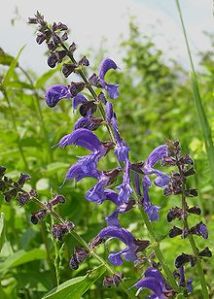
Sage is a lovely and important medicinal herb, also a sacred one. I grow several varieties and am always adding more. My garden is never without the traditional garden sage, salvia officinalis. There are some variations of this kind, the fuzzy leafed and tricolored sage, but I still like the good old standby that came to America with the early colonists. You may not realize how many varieties of sage are native to the New World, and their many uses, medical and spiritual. Scarlet sage attracts hummingbirds and is striking in the border, but there are many beautiful varieties. 
Sage (Salvia) Common name: Wild Sage, Meadow Sage (S. pratensis) Scarlet Sage or Texas Sage (Salvia coccinea), Chia Sage grows throughout southern Canada and the United States, the very important chia (S. columbriae) in Arizona, Utah, Nevada, and California.
Meadow Sage
From Field Guide to Medicinal Wild Plants by Bradford Angier:

I love this book, given to me by my dear grandmother who lived to be 99 and a half. Mr. Angier has also written other volumes.
Sage is a fuzzy perennial with soft, downy hairs. One characteristic is that, when a bunch is wadded together, it clings to itself, remaining a compact mass. The erect stems are greyish with down and have, on pubescent stalks toward their bases, up to about 18-inch-long leaves. 
Several wheels of tiny blue or whitish, and sometimes reddish, flowers grow in whorls of four to eight, depending on the particular species. The plants have an easily recognized strong, unique, aromatic odor.
Chia  Sage (S. columbriae)The chia variety, a distinctive annual springing up in the Southwest at the start of the late fall rains and an Indian standby, is a rough sage with deeply incised, coarse, usually hairy, dark-green leaves that grow mostly close to the ground. Three or so whirls of small blue flowers circle, mint like, in separated densities above prickly, dark-red, leafy bracts. These mature into seed-filled pods that remain like skeletons when the rest of the plant has withered, not giving the winds enough purchase to blow them free, and leaving them for the Indians to gather.
The seeds of the Texas sage (S. coccinea) are oblong, angular, or bowed, and 2 to 3 millimeters in size. Those of the annual scarlet sage take two or three weeks to emerge.
Scarlet Sage, Salvia coccineaThe medicinal part of the plant in general is the leaves, harvested during the flowering period in June and July. In the case of the chia, the vital part is the seeds, which are gathered from the then nearly dead annual in July.
Steeped like tea and in the same proportions, sage tea was slightly tonic and quieting to a disordered stomach. It’s peculiar but pleasant odor was retained in the beverage by the warmish, somewhat bitter aroma of the extracted volatile oil. It was said to benefit a ticklish and irritated throat, to quiet and expel bothersome gas, and assist the liver, kidneys, and gallbladder. Regarded in many regions as effective in treating sore throat, accompanied by fever, cankers, sore gums, mouth ulcers, and swollen tonsils, and as an effective gargle. The juice from bruised fresh leaves was credited with helping to remove warts, also pressed into service for sores, cuts, and wounds. The Indians made a salve of the crushed fresh leaves and edible lard for these purposes. Some tribes made salve from the roots of wild sage (S. lyrata).
A refreshing drink for hot weather was made by mixing chia seeds with cool water, each seed becoming separately suspended in its own white, mucilaginous cloudiness. The white, gray, and brown seeds are so nutritious that a teaspoonful was regarded as enough to sustain an Indian for a day on a forced journey.
JosephHenry Sharp-Making Sweet Grass Medicine - Blackfoot CeremonyNative American Smudging Ceremony: From The Smudging Ceremony
"Our Native elders have taught us that before a person can be healed or heal another, one must be cleansed of any bad feelings, negative thoughts, bad spirits or negative energy - cleansed both physically and spiritually.,,Native people throughout the world use herbs to accomplish this. One common ceremony is to burn certain herbs, take the smoke in one's hands and rub or brush it over the body. Today this is commonly called "smudging." In Western North America the three plants most frequently used in smudging are sage, cedar, and sweetgrass.
Many varieties of sage have been used in smudging. The botanical name for "true" sage is Salvia (e.g. Salvia officinalis, Garden Sage, or Salvia apiana, White Sage). It is interesting to note that Salvia comes from the Latin root salvare, which means "to heal." There are also varieties of sage which are of a species separate from Salvin Artemusia. Included here are sagebrush (e.g. Artemisia californica) and mugwort (Artemisia vulgaris). We have seen both Salvia and Artemisia sub-species used in smudging."
I've discussed salvia officinalis (pictured below) in another post, but briefly: Salvia officinalis (called garden or common sage) is a perennial, evergreen subshrub, with woody stems, grayish leaves, and blue to purplish flowers. A member of the family Lamiaceae, sage is native to the Mediterranean region, though it has naturalized in many places throughout the world.
"Native Americans consider sage, cedar, sweetgrass and tobacco as the Four Sacred Herbs. Sage is found across North America, with white sage being the most potent and gray sage found in many northern areas where the gray will not over-winter. Cedar (Eastern red cedar) (Eastern white cedar) and sweetgrass also are indigenous to this continent. Tobacco can be found in many forms; however for this ceremony Nicotiana Rustica, or a similar dried tobacco leaf, native to America is preferred."