O’Keeffe (A Beggar on Horseback, 1798) ~ “My dear, have some lavender, or you’d best have a thimble full of wine,
your spirits are quite down, my sweeting.”

I love lavender, such a wonderful fragrance,
among the best in the world. Every year we plant more seedlings, in an
effort to keep them going. Lavender is one of those herbs we have
difficulty getting through our harder winters and so may or may not come
back. Of the different kinds we’ve grown, Lavender Munstead seems to be
the hardiest. Being dwarf, it doesn’t get too big to interplant among
other herbs and roses. We are trying a new tiny variety this season
that has bloomed for weeks, so shall see if it survives. Its name escapes me,
but the grower can be found again next spring. The French variety from Provence
has the most exquisite fragrance but isn’t very hardy. If possible,
provide a sunny sheltered location out of strong north-west winds for lavender and the plants will be longer lived. Prune back dead growth in the spring. We will be
planting more, that's a given.

Lavender flowers are easily dried, make
delightful sachets, and are an essential ingredient in potpourri. I
suppose one could ‘make do’ with rose petals, but I like a mix of both along
with other herbs, spices, and essential oils. In addition to its highly
valued scent, lavender has a history of medicinal use and a rich lore. I rely on the essential oil in the house, even sprinkle drops on the dog’s brush
several times a week. Lavender oil repels insects and doesn’t harm the dog as
some essential oils can when used directly on pets. Be extremely careful around
cats.
Turner (Herbal, 1545) ~ ”I judge that the flowers of lavender quilted in a cappe and dayly
worn are good for all diseases of the head that come of a cold cause and that
they comfort the braine very well.”
The following is from A Modern Herbal:
“The fragrant oil to which the odour of Lavender
flowers is due is a valuable article of commerce, much used in perfumery, and
to a lesser extent in medicine. The fine aromatic smell is found in all parts
of the shrub, but the essential oil is only produced from the flowers
and flower-stalks. Besides being grown for the production of this oil, Lavender
is widely sold in the fresh state as ‘bunched Lavender,’ and as ‘dried
Lavender,’ the flowers are used powdered, for sachet making and also for
pot-pourri…
ENGLISH LAVENDER (Lavandula vera), the common
narrow-leaved variety, grows 1 to 3 feet high (in gardens, occasionally
somewhat taller), The majority of the oil yielded by the flowers is contained
in the glands on the calyx. The two-lipped corolla is of a beautiful
bluish-violet colour.
French Lavender oil
is distilled from two distinct plants, found in the mountain districts of
Southem France, both included under the name of L. officinalis by the
sixteenth-century botanists, and L. vera by De Candolle. The
oils from the two plants are very similar, but the former yields oils with the
higher percentage of esters.

(image from our garden)
The SPIKE LAVENDER (L. spica, D.C., or latifolia, Vill.) is a coarser,
broadleaved variety of the Lavender shrub, also found in the mountain districts
of France and Spain, The flowers yield three times as much of the essential oil
– known as Spike oil – as can be got from our narrowleaved plant, but it is of
a second-rate quality, less fragrant than that of the true Lavender, its odour
resembling a mixture of the oils of Lavender and Rosemary. Parkinson in his Garden of Pleasure says the L. spica ‘is often called the
Lesser Lavender or minor, and is called by some, Nardus Italica.’ Some believe
that this is the Spikenard mentioned in the Bible.
History: Dr. Fernie, in Herbal Simples, says: ‘By the Greeks the name Nardus is given to
Lavender, from Naarda, a city of Syria near the Euphrates, and many persons
call the plant “Nard.” St. Mark mentions this as Spikenard, a thing of great
value…. In Pliny’s time, blossoms of the Nardus sold for a hundred Roman
denarii (or L.3 2s. 6d.) the pound. This Lavender or
Nardus was called Asarum by the Romans, because it was not used in
garlands or chaplets. It was formerly believed that the asp, a dangerous kind
of viper, made Lavender its habitual place of abode, so that the plant had to
be approached with great caution.’
L. Stoechas Another species of LAVENDER, L. Stoechas, known also as French
Lavender, forms a pretty little shrub, with narrow leaves and very small, dark
violet flowers. It is very abundant on the islands of Hyères, which
the Ancient Romans called the ‘Stoechades,’ after this plant. This
was probably the Lavender so extensively used in classical times by the Romans
and the Libyans, as a perfume for the bath (whence probably the plant derived
its name – from the Latin, lavare, to wash). It is plentiful
in Spain and Portugal and is only used as a rule for strewing the floors of
churches and houses on festive occasions, or to make bonfires on St. John’s
Day, when evil spirits are supposed to be abroad, a custom formerly observed in
England with native plants.
The odour is more akin to Rosemary than to
ordinary Lavender. The flowers of this species were used medicinally in England
until about the middle of the eighteenth century, the plant being called by our
old authors, ‘Sticadore.’ It was one of the ingredients of the ‘Four Thieves’
Vinegar’ famous in the Middle Ages.
The Dwarf Lavender is more compact than the other
forms and has flowers of a deeper colour. It makes a neat edging in the fruit
or kitchen garden, where the larger forms might be in the way, and the flowers,
borne abundantly, are useful for cutting.

(Image from our garden)
All the forms of Lavender are much visited by
bees and prove a good source of honey.
Lavender was familiar to Shakespeare, but was
probably not a common plant in his time, for though it is mentioned by Spencer
as ‘The Lavender still gray’ and by Gerard as growing in his garden, it is not
mentioned by Bacon in his list of sweet-smelling plants. It is now found in
every garden, but we first hear of it being cultivated in England about 1568.
It must soon have become a favourite, however, for among the long familiar
gardenplants which the Pilgrim Fathers took with them to their new home in
America, we find the names of Lavender, Rosemary and Southernwood, though John
Josselyn, in his Herbal, says that ‘Lavender Cotton
groweth pretty well,’ but that ‘Lavender is not for the Climate.’
Medicinal Action and Uses: Lavender was used in earlier days as a condiment and for flavouring
dishes ‘to comfort the stomach.’ Gerard speaks of Conserves of Lavender being
served at table. It has aromatic, carminative and nervine properties.
Though largely used in perfumery, it is now not much employed internally,
except as a flavouring agent, occurring occasionally in pharmacy to cover
disagreeable odours in ointments and other compounds.
Red Lavender lozenges are employed both as a mild
stimulant and for their pleasant taste.
The essential oil, or a spirit of Lavender made
from it, proves admirably restorative and tonic against faintness, palpitations
of a nervous sort, weak giddiness, spasms and colic. It is agreeable to the
taste and smell, provokes appetite, raises the spirits and dispels flatulence.
The dose is from 1 to 4 drops on sugar or in a spoonful or two of milk.
A few drops of the essence of Lavender in a hot
footbath has a marked influence in relieving fatigue. Outwardly applied, it
relieves toothache, neuralgia, sprains, and rheumatism. In hysteria, palsy and
similar disorders of debility and lack of nerve power, Lavender will act as a
powerful stimulant.
‘It profiteth them much,’ says Gerard, ‘that have
the palsy if they be washed with the distilled water from the Lavender flowers,
or are anointed with the oil made from the flowers and olive oil in such manner
as oil of roses is used.’
Culpepper says that: ‘a decoction made with
the flowers of Lavender, Horehound, Fennel and Asparagus root, and a little
Cinnamon, is very profitably used to help the falling-sickness (epilepsy) and
the giddiness or turning of the brain.’
Salmon in his Herbal (1710) says that: ‘it
is good also against the bitings of serpents, mad-dogs and other venomous
creature, being given inwardly and applied poultice-wise to the parts wounded.
The spirituous tincture of the dried leaves or seeds, if prudently given, cures
hysterick fits though vehement and of long standing.’
In some cases of mental depression and delusions,
oil of Lavender proves of real service, and a few drops rubbed on the temple
will cure nervous headache.
A tea brewed from Lavender tops, made in moderate
strength, is excellent to relieve headache from fatigue and exhaustion, giving
the same relief as the application of Lavender water to the temples. An
infusion taken too freely, will, however, cause griping and colic, and Lavender
oil in too large doses is a narcotic poison and causes death by convulsions.
Lavender's use in the swabbing of wounds obtained
further proof during the War, and the French Academy of Medicine is giving
attention to the oil for this and other antiseptic surgical purposes. The oil
is successfully used in the treatment of sores, varicose ulcers, burns and
scalds. In France, it is a regular thing for most households to keep a bottle
of Essence of Lavender as a domestic remedy against bruises, bites and trivial
aches and pains, both external and internal.

Lavender Water can
easily be prepared at home. Into a quart bottle are put 1 OZ. essential oil of
Lavender, one drop of Musk and 1 1/2 pint spirits of wine. These three
ingredients are well mixed together by shaking. The mixture is left to settle,
shaken again in a few days, then poured into little perfume bottles fitted with
air-tight stoppers. This is another recipe from an old family book:
‘Put into a bottle half a pint of spirit of wine
and two drachms of oil of lavender. Mix it with rose-water, five ounces,
orange-flower water, two ounces, also two drachms of musk and six ounces of
distilled water.’
This is stated to be ‘a pleasant and efficacious
cordial and very useful in languor and weakness of the nerves, lowness of
spirits, faintings, etc.’
Lavender
Vinegar. A refreshing toilet preparation is made by
mixing 6 parts of Rosewater, 1 part of spirits of Lavender and 2 parts of
Orleans vinegar.
It can also be prepared from freshly gathered
flower-tops. These are dried, placed in a stoppered bottle and steeped for a
week in Orleans vinegar. Every day the bottle must be shaken, and at the end of
the week the liquid is drained off and filtered through white blotting
paper."
There are many, many ways to enjoy lavender and
benefit from this wonderful herb. I hope you are inspired to put in a few plants this year, or grow one in a pot.
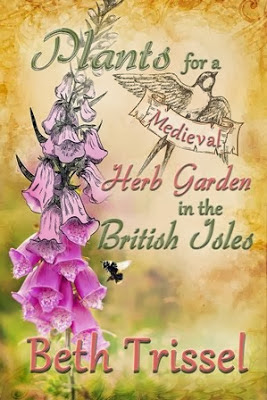
- Nonfiction Herbal
My herbal, Plants for A Medieval Herb Garden in the British Isles, is in print and kindle at Amazon: https://www.amazon.com/Plants-Medieval-Garden-British-Isles-ebook/dp/B00IOGHYVU
An illustrated collection of plants that could have been grown in a Medieval Herb or Physic Garden in the British Isles. The major focus of this work is England and Scotland, but also touches on Ireland and Wales. Information is given as to the historic medicinal uses of these plants and the rich lore surrounding them. Journey back to the days when herbs figured into every facet of life, offering relief from the ills of this realm and protection from evil in all its guises.