Showing posts with label Ruth Stout. Show all posts

Monday, March 25, 2013

March in the Shenandoah Valley of Virginia


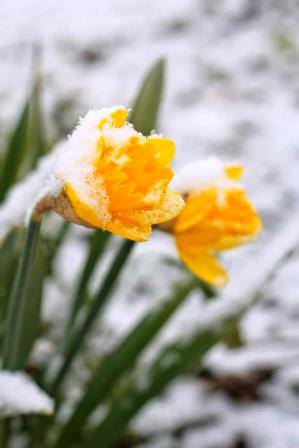
daffodils in March snow“It was one of those March days when the sun shines hot and the wind blows cold: when it is summer in the light, and winter in the shade.” ~Charles Dickens,  To this famous quote I add, ‘and then it snowed.’
“It’s spring fever.  That is what the name of it is.  And when you’ve got it, you want – oh, you don’t quite know what it is you do want, but it just fairly makes your heart ache, you want it so!”  ~Mark Twain
I heartily agree, and so I worked in my gardens on Saturday, quite mild out really, and daughter Elise  helped, which was greatly appreciated by this weary gardener. We got the peas and early greens…lettuce, bright lights Swiss chard, spinach, pok choy…plus radishes and assorted kinds of beets planted. *All heirloom seed. I added three Crimson rhubarb roots to the patch of red rhubarb. Only the traditional ‘been here forever’ green variety is reliably robust, but we keep trying. And then Sunday, Palm Sunday, (the little children were so precious at church waving their palms) it began to snow about mid afternoon. Same thing happened last Sunday. By this morning we have at least ten inches of the white stuff covering everything.
Elise went out yesterday with her camera at the start of the snow and took some lovely shots. Our old red barn with pussy willow in foreground.
snowy pussywillow by the old red barn on march 25
“Awake, thou wintry earth -
Fling off thy sadness!
Fair vernal flowers, laugh forth
Your ancient gladness!
~Thomas Blackburn, “An Easter Hym
I hope the snow clears out by next weekend, which is Easter. Too early this year for me, but there it is. And I do love Easter whenever it comes.
“I love spring anywhere, but if I could choose I would always greet it in a garden.” ~Ruth Stout
This is one of my most favorite spring quotes. I fully agree with Ruth Stout and have done so. I am also attempting to practice her no till gardening method. Image below of the seeds (packets are on the stakes) I planted on Saturday before Sunday’s snow with the pussy willow, wheelbarrow, and barn in the pic.
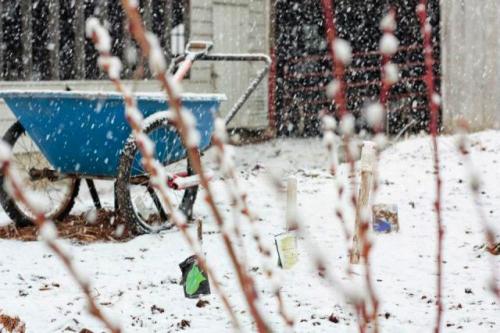
Seeds I planted the day before the snow on March 24th
“No matter how long the winter, spring is sure to follow.” ~Proverb
“Spring is when you feel like whistling even with a shoe full of slush.”  ~Doug Larson
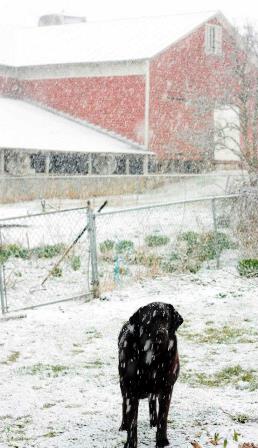
Luca in the snow March 2013“Every spring is the only spring – a perpetual astonishment.”  ~Ellis Peters
“In the spring I have counted one hundred and thirty-six different kinds of weather inside of four and twenty hours.”  ~Mark Twain (And so say all of us!)
“I think that no matter how old or infirm I may become, I will always plant a large garden in the spring.  Who can resist the feelings of hope and joy that one gets from participating in nature’s rebirth?”  ~Edward Giobbi
To this I add, I hope I will have help with my gardens. Image of our rescue farm dog, Luca, at the start of the snow. We have two rescue farm dogs.
“The front door to springtime is a photographer’s best friend.” ~Terri Guillemets
Amen to that!
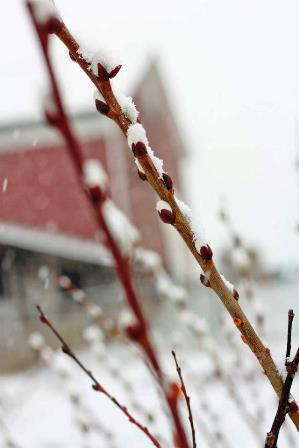
pussywillow against the barn in March 25 snow
We rooted pussy willow shoots in the garden last spring and were amazed that they all took off, and now we have a dozen blooming willows to move and give away to good homes. Some we will plant by the farm pond, but they cannot remain where they are because pussy willows grow far too large, even when pruned to keep in a garden.
Oh look, it’s snowing again.
“Yesterday the twig was brown and bare;
To-day the glint of green is there;
Tomorrow will be leaflets spare;
I know no thing so wondrous fair,
No miracle so strangely rare.
I wonder what will next be there!”
~L.H. Bailey
“First a howling blizzard woke us,
Then the rain came down to soak us,
And now before the eye can focus —
Crocus.”  ~Lilja Rogers
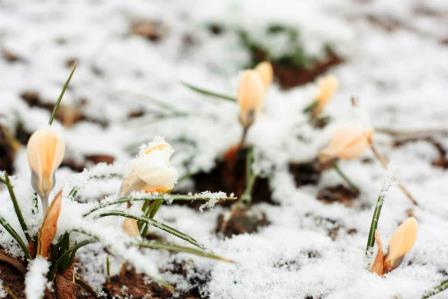
snpw crocus on march 25th

Thursday, April 19, 2012

“I love spring anywhere, but if I could choose I would always greet it in a garden.” ~ Ruth Stout


Spring came early this year to the Shenandoah Valley, though the weather has been, 'right mixy," to use a local country expression.Even more than usual for spring in these parts.

If it could always be spring….what joy.   And I’m allergic to it, been on shots and meds for years, but I love it anyway, I say as I sit here sniffling.  But such beauty sends the spirit soaring, despite the sneezing. These Virginia bluebells were given to me by my dear grandmother and have spread wonderfully in the dappled shade.

And best of all, I’m  back in the garden, with the usual accompanying aches as I get into what I call ‘gardening form.’   Or attempt to.
I come from a long line of plant lovers and inherited the gardening gene.  I’ve passed it on to my younger daughter, my right arm in the garden, but all of my children are fans.  And now ‘the smalls,’ the grandbabies, are our new crop of apprentices. My seven yr old grandson is of some real help.  

Sometimes the four yr olds are a modicum of  use, or not terribly at odds with the agenda.  But two yr olds and under are no help at all.  Nor, I might add, are well-meaning dogs who lie on plants.  One of our dogs, a lab mix, eats asparagus, corn, and tomatoes.  He’s worse than groundhogs and raccoons, so we’ve secured our fence against him.  I think…

My main recommendation when it comes to gardening is to use a lot of compost and natural mulch, like well-rotted hay or straw, even leaves, in your vegetable and flower beds. Robust plants better resist insects and disease.  Earth worms are a gardener’s best friend and thrive in natural mulch, humus-enriched soil.  I’ve even gone on worm finds and introduced more into the gardens, plus bought them from a reputable online source.  Yes, I’m nuts over worms as are my grandbabies now. Thanks to my enthusiasm, they think worms totally rock.  

My dream is to have the perfect garden like Mr. McGregor‘s in Peter Rabbit.  Dream on, I say to self. But I'm ever the dreamer, especially in the spring. Everything seems possible then. Even heaven on earth.

Avoid chemical fertilizers and pesticides or you’ll kill the worms and other beneficial insects. I mix up an organic brew to spray on susceptible plants to fight diseases and battle our most voracious pests.  I’m currently experimenting with concoctions. I like an online site called Gardens Alive that sells environmentally responsible products. 

To whatever organic brew I’m using from them, I add a Tablespoon of baking soda, liquid kelp or seaweed fertilizer, and insecticidal soap per gallon.  I avoid fish based liquid fertilizers as the scent attracts the barn cats who take undo interest in the plants.  I can’t say for certain how well any of my brews work, but at least I’m not hurting anything. ‘Do no harm,’ the physicians creed also applies in the garden.  Even organic insecticides can kill the good bugs and butterflies, so use with great caution.

My primary focus in gardening is our vegetable, perennial & annual flower and herb beds.  I’m particularly fond of herbs and old-fashioned cottage garden plants, those heirloom flowers and vegetables passed down from generation to generation.  

Some of these vintage varieties involve saving seed and ordering from specialty catalogs.  Those herbs and flowers that attract butterflies, hummingbirds, songbirds, and honey bees are of special interest to me. I strive to create a wildlife sanctuary of sorts.  The American love of a chemically dependent green lawn is the opposite of what beneficial insects and wildlife need, and plants for that matter.  Think wildflowers and herbs.  Rejoice in the butterflies and hummers that will follow.
We rotate annual our garden vegetables as well as practicing companion planting. Time honored combinations we’ve tried, as well as making some of our own discoveries, are to plant nasturtiums and radishes closely around the cucurbit family (commonly called the cucumber, gourd, melon, or pumpkin family) help to deter the squash vine borer and cucumber beetles which are deadly to the plants. This family is our most trouble prone, so gets the greatest attention when it comes to companion planting.  

Radishes are also a good companion for lettuce, spinach, and carrots.  If I were to choose one companion plant it would be radishes and the second, nasturtiums, but there are many excellent choices and we’re learning more all the time about effective combinations. (Image of lemon scented marigolds, also of  benefit.)
I interplant garlic with roses and have beneficial effects in warding off some of the pests and diseases that attack them.  *I prefer the old-time roses and David Austen varieties that combine the best of the old with the repeat bloom of the new.  My favorite rose is Abraham Darby by David Austen. I just planted a new one.

Tomatoes grow more happily when planted near basil.  Peppers also like it. Sweet marjoram, which reseeds itself for us, is another beneficial herb to interplant with vegetables and flowers.  Mint helps deter cabbage worms.   

Pumpkins and squash better survive when rotated from their usual spots.  This year we tucked a pumpkin in among the massive, native clematis vine growing along the backyard fence that we refer to as ‘the beast.’ The borers didn’t find it, plus ‘the beast’ helped cradle the orange globes.
 
We’ve observed that old-fashioned sunflowers with multiple heads (planted by birds from the birdseed variety) grow the most vigorously.  Sunflowers attract masses of goldfinches, a favorite songbird, and when planted in and around corn, reduce army worms in the ears.  

Marigolds are an excellent companion plant for vegetable and flowers to help ward off Japanese beetles.  Borage enriches the soil, attracts honey bees, and is another good companion for squash.  Onions planted near carrots help repel the carrot fly.  Chamomile (German, the annual variety) is another good companion plant but use it sparingly.  The perennial form of chamomile, Roman (Anthemis nobilis) is creeping all over the place and makes a lovely fragrant ground cover at the border of other herbs and flowers.

Encourage beneficial insects to make their home in your garden and experiment with companion planting. Avoid monochromatic schemes and think variety.  And remember the old-time, non hybrid varieties of flowers and vegetables.  A great book about growing heirloom plants and sharing them with others is Passalong Plants.  A delightful book chocked full of information. And Happy gardening!

Garden images taken by daughter Elise. Well, most of them.