Showing posts with label Colonial American Christmas Romance. Show all posts

Saturday, November 26, 2016

Vintage Christmas Cards & A Colonial American Christmas Romance


Ever wonder about the history of Christmas Cards in America? Here’s what I found.
From Something Olde: Christmas Card History
“In the late 1700’s merchants sent their customers best wishes for the new year. The cards were created on lithographs and hand-colored. A lithograph is an etching on a stone that can be reproduced on paper. Sending Christmas cards first became popular in England over 150 years ago.  In the 1840’s John Calcott Horsely was a curator at the royal museum.  He was late sending his usual holiday letters to his friends and relatives for Christmas.  He asked the artist, Sir Henry Cole, to design and hand-color 1,000 cards.  He wanted the card to show people being fed and clothed to remind his friends of the needs of the poor during this season.”
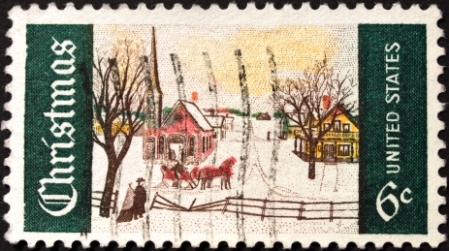
Holiday Cards
The first American to print and sell Christmas cards was Louis Prang of Roxbury, Massachusetts, who began publishing cards in 1875.
(In 1953) President Dwight D. Eisenhower is given credit for sending the first “official” Christmas card from the White House. An art print also became the standard Christmas gift for the president’s staff, a practice continued to this day.
Vintage Santa Christmas CardFrom Idea Finder: “A relatively recent phenomenon, the sending of commercially printed Christmas cards originated in London in 1843. Previously, people had exchanged handwritten holiday greetings. First in person. Then via post. By 1822, homemade Christmas cards had become the bane of the U.S. postal system. That year, the Superintendent of Mails in Washington, D.C., complained of the need to hire sixteen extra mailmen. Fearful of future bottlenecks, he petitioned Congress to limit the exchange of cards by post, concluding, “I don’t know what we’ll do if it keeps on.”
Not only did it keep on, but with the marketing of attractive commercial cards the postal burden worsened. The first Christmas card designed for sale was by London artist John Calcott Horsley. A respected illustrator of the day, Horsley was commissioned by Sir Henry Cole, a wealthy British businessman, who wanted a card he could proudly send to friends and professional acquaintances to wish them a “merry Christmas.”
Christmas sleigh rideFrom The History of Christmas Cards: At Christmastime, many people would send letters to friends and family far away, and children at boarding school would decorate paper and write letters to show off the writing skills they’d improved upon that term at school. However, the first official Christmas card was created in 1843 in Britain.
Sir Henry Cole, director of London’s Victoria and Albert Museum, would write letters to family and acquaintances at Christmastime. He and others could buy decorative paper on which to pen greetings and good wishes, but he found it to be a cumbersome task. So Cole commissioned an artist friend, John Calcott Horsley to create a card with a simple message that could be duplicated and sent to all his acquaintances. Horsley lithographed and hand-colored 1,000 copies of this first commercial card. It was a three-panel card – the center panel showed a family celebrating and the two wing panels depicted people feeding the hungry and clothing the naked. The card bore the simple greeting, “A Merry Christmas and a Happy New Year to You,” which would become the standard sentiment of the mass-produced Christmas cards.
old time SantaCHRISTMAS CARDS RISE IN POPULARITY
“Christmas cards were quite elaborate and though the lithograph printing process helped in producing cards, they first became popular among the upper-class in England. However, the development and improvement of the postal system, making sending cards more affordable, was a big part of the rise in the popularity of Christmas cards. Early cards were not necessarily religious Christmas cards but favored images such as beautiful flowers, birds, scenery and other pretty things.
In 1875 Louis Prang brought the commercial Christmas card to the United States. Prang, a German lithographer, had developed a new innovative way of printing that made the process of creating Christmas and other cards much simpler and more affordable. Like British Christmas cards, Prang’s cards included various images that were simply pretty and tasteful, not truly having much to do with Christmas or even necessarily winter. However, some cards did include holly, snow and some other wintry or Christmas images. His cards became extremely popular in the U.S.; his company printed almost five million cards a year by 1881.”
christmas-holly
Well, you get the idea. In my holiday release, A Warrior For Christmas, (also in audio) I journeyed farther back in early America to the colonial time period and the holiday celebration in a wealthy household. However, the hero, a former Shawnee captive, would rather return to his adopted people in the colonial frontier.
Blurb: Reclaimed by his wealthy uncle, former Shawnee captive Corwin Whitfield finds life with his adopted people at an end and reluctantly enters the social world of 1764. He plans to return to the colonial frontier at his first opportunity–until he meets Uncle Randolph’s ward, Dimity Scott.
Deaf since a childhood bout of Scarlet fever, Dimity Scott intends to be cherished for herself, not her guardian’s purse, even if it means risking spinsterhood. Then the rugged newcomer arrives, unlike any man she’s ever known. Dimity has learned to manage her silent world, but unaccustomed to the dangers of the frontier, can she expect love and marriage from Corwin, who longs to return to his Shawnee life?~
***A Warrior for Christmas is available from all major online booksellers including Amazon and Barnes & Noble.
Christmas Bells“I will honor Christmas in my heart, and try to keep it all the year.”  ~Charles Dickens


Monday, November 25, 2013

Early American Christmas Cards and My Colonial Christmas Romance


Ever wonder about the history of Christmas Cards in America? Here’s what I found.
From Something Olde: Christmas Card History
“In the late 1700’s merchants sent their customers best wishes for the new year. The cards were created on lithographs and hand-colored. A lithograph is an etching on a stone that can be reproduced on paper. Sending Christmas cards first became popular in England over 150 years ago.  In the 1840’s John Calcott Horsely was a curator at the royal museum.  He was late sending his usual holiday letters to his friends and relatives for Christmas.  He asked the artist, Sir Henry Cole, to design and hand-color 1,000 cards.  He wanted the card to show people being fed and clothed to remind his friends of the needs of the poor during this season.”
Holiday Cards
The first American to print and sell Christmas cards was Louis Prang of Roxbury, Massachusetts, who began publishing cards in 1875.
(In 1953) President Dwight D. Eisenhower is given credit for sending the first “official” Christmas card from the White House. An art print also became the standard Christmas gift for the president’s staff, a practice continued to this day.
From Idea Finder:   “A relatively recent phenomenon, the sending of commercially printed Christmas cards originated in London in 1843. Previously, people had exchanged handwritten holiday greetings. First in person. Then via post. By 1822, homemade Christmas cards had become the bane of the U.S. postal system. That year, the Superintendent of Mails in Washington, D.C., complained of the need to hire sixteen extra mailmen. Fearful of future bottlenecks, he petitioned Congress to limit the exchange of cards by post, concluding, “I don’t know what we’ll do if it keeps on.”
Not only did it keep on, but with the marketing of attractive commercial cards the postal burden worsened. The first Christmas card designed for sale was by London artist John Calcott Horsley. A respected illustrator of the day, Horsley was commissioned by Sir Henry Cole, a wealthy British businessman, who wanted a card he could proudly send to friends and professional acquaintances to wish them a “merry Christmas.”
From The History of Christmas Cards: At Christmastime, many people would send letters to friends and family far away, and children at boarding school would decorate paper and write letters to show off the writing skills they’d improved upon that term at school. However, the first official Christmas card was created in 1843 in Britain.
Sir Henry Cole, director of London’s Victoria and Albert Museum, would write letters to family and acquaintances at Christmastime. He and others could buy decorative paper on which to pen greetings and good wishes, but he found it to be a cumbersome task. So Cole commissioned an artist friend, John Calcott Horsley to create a card with a simple message that could be duplicated and sent to all his acquaintances. Horsley lithographed and hand-colored 1,000 copies of this first commercial card. It was a three-panel card – the center panel showed a family celebrating and the two wing panels depicted people feeding the hungry and clothing the naked. The card bore the simple greeting, “A Merry Christmas and a Happy New Year to You,” which would become the standard sentiment of the mass-produced Christmas cards.
CHRISTMAS CARDS RISE IN POPULARITY
“Christmas cards were quite elaborate and though the lithograph printing process helped in producing cards, they first became popular among the upper-class in England. However, the development and improvement of the postal system, making sending cards more affordable, was a big part of the rise in the popularity of Christmas cards. Early cards were not necessarily religious Christmas cards but favored images such as beautiful flowers, birds, scenery and other pretty things.
In 1875 Louis Prang brought the commercial Christmas card to the United States. Prang, a German lithographer, had developed a new innovative way of printing that made the process of creating Christmas and other cards much simpler and more affordable. Like British Christmas cards, Prang’s cards included various images that were simply pretty and tasteful, not truly having much to do with Christmas or even necessarily winter. However, some cards did include holly, snow and some other wintery or Christmas images. His cards became extremely popular in the U.S.; his company printed almost five million cards a year by 1881.”
Well, you get the idea. In my holiday release, A Warrior For Christmas, (also in audio now!) I journeyed farther back in early America to the colonial time period and the holiday celebration in a wealthy household.  However, the hero, a former Shawnee captive, would rather return to his adopted people in the colonial frontier.
Blurb: Reclaimed by his wealthy uncle, former Shawnee captive Corwin Whitfield finds life with his adopted people at an end and reluctantly enters the social world of 1764. He plans to return to the colonial frontier at his first opportunity–until he meets Uncle Randolph’s ward, Dimity Scott.
Deaf since a childhood bout of Scarlet fever, Dimity Scott intends to be cherished for herself, not her guardian’s purse, even if it means risking spinsterhood. Then the rugged newcomer arrives, unlike any man she’s ever known. Dimity has learned to manage her silent world, but unaccustomed to the dangers of the frontier, can she expect love and marriage from Corwin, who longs to return to his Shawnee life?~
***A Warrior for Christmas is available from all major online 
booksellers including Amazon and Barnes & Noble.

Friday, December 7, 2012

Caroling and my New Historical Christmas Romance


Caroling, a time-honored tradition contemplated with fondness and nostalgia can, in reality, be an exhausting ordeal for the carolers as well as the carolees. One December, many moons ago, my husband cleaned up our big old farm truck so the young parents and children from our church could brighten that wintry evening for the elderly and shut-ins. Bundled against the frosty air, we clambered into the back of the truck. Some of the less agile women and children had to be lifted by a few of the husky men and pitched into the bed, still smelling of manure--the truck, not the women and children. Then my husband revved up the motor and off we lurched into the starry night, singing merrily.
As our crowd of carolers overwhelmed the smaller homes and apartments, some of the shut-ins had to be assisted out of their cozy chairs, or warm beds (at least one was down for the night, or so they’d thought) to stand on frigid porches, leaning on canes, clutching a shawl to their shoulders, to smile and wave, expressing their pleasure that yet another group brimming with Yuletide cheer had remembered them. I wondered if they later requested that the church remove their names from the list of shut-ins.
Those individuals with ample room invited us in for refreshments, insisting we share the trove of cookies we and other groups had brought them. It wasn’t long before the children launched into sugar highs and we adults, who hated to disappoint our hosts, began to feel rather ill from all the treats we’d consumed–worsened by the jouncing truck.
And then there was the problem with our route. Not having planned it very efficiently, a member of our zealous band would suddenly remember some neglected soul across town which meant a long chilly ride in the teeth of the biting wind. Despite our exhaustion and rising queasiness, we felt compelled to push ever forward, dragging our fussy children along, to bring the joy of Christmas at last to the needy folk in the nursing home. 
As we trooped up the hall, I overheard one elderly resident, weary but resigned, comment, “We’ve had carolers every night this week.”
And that, my friends, is the last time I ever went caroling.  But for those of you who insist on this holiday undertaking, I suggest giving your route some thought beforehand, limit the number of homes you visit.  Here’s a wild thought, maybe even call ahead to see if people actually want carolers.  I don’t, unless you’re wearing costumes like the ones in A Christmas Carol and sing those lovely Old English tunes.  Also,  find some other transport besides the back of a freezing cold  farm truck, and bring treats you actually want to eat because they will be offered to you.


And God Bless us everyone.~

For historical romance lovers, my new Christmas novella set in colonial America, A Warrior for Christmas,  is now out.

Story Blurb:

Reclaimed by his wealthy uncle, former Shawnee captive Corwin Whitfield finds life with his adopted people at an end and reluctantly enters the social world of 1764. He plans to return to the colonial frontier at his first opportunity--until he meets Uncle Randolph's ward, Dimity Scott.

Deaf since a childhood bout of Scarlet fever, Dimity Scott intends to be cherished for herself, not her guardian's purse, even if it means risking spinsterhood. Then the rugged newcomer arrives, unlike any man she's ever known. Dimity has learned to manage her silent world, but unaccustomed to the dangers of the frontier, can she expect love and marriage from Corwin, who longs to return to his Shawnee life?

***A Warrior for Christmas is available in various ebook formats at The Wild Rose Press,  Amazon Kindle, Barnes & Noble’s Nookbook & other online booksellers.


Wednesday, December 5, 2012

In Time for the Holidays--Historical Romance A Warrior for Christmas--Beth Trissel

AWarriorforChristmas_7288_680
One unique feature of this story is that Dimity Scott is deaf from scarlet fever and the setting is colonial America. Another unusual twist, former Shawnee captive and white warrior, Corwin Whitfield, would rather return to his adopted people and the frontier than inherit a costly estate. Until he meets Dimity. Then he’s in a quandary.
After wealthy Uncle Randolph reclaims Corwin following a treaty with the Indians that requires the return of white captives, he’s given a swift course in etiquette and hustled back into the fashionable world of colonial high society—a life that holds little appeal for Corwin. Expectations that he will learn to manage and ultimately inherit the family estate and undertake the care of his uncle’s ward, Dimity Scott, clash with his restless desire to return to the frontier. Any hope that he might take the unexpectedly desirable Dimity with him dissipate when he realizes the risk for her in a hard land where every sense must be tuned to danger. And Dimity won’t allow him to sacrifice his happiness for her. Nor can she abide pity, and he isn’t the only man who finds her worth winning.
Early American Sleigh RideIf you wonder how Dimity and Corwin communicate in an age before sign language and other advances for the deaf existed, so did I. But the results are surprising and not a little bit wonderful. And then there are the charming traditions of celebrating Christmas in colonial America. A Warrior for Christmas is a story I much enjoyed researching and writing. I hope you will enjoy it too.
Christmas decorationBlurb: Reclaimed by his wealthy uncle, former Shawnee captive Corwin Whitfield finds life with his adopted people at an end and reluctantly enters the social world of 1764. His one aim is to run back to the colonial frontier at his first opportunity––until he meets Uncle Randolph’s ward, Dimity Scott.
Resolved to be cherished for herself, not her guardian’s purse, Dimity resigns herself to spinsterhood. Then the rugged newcomer arrives, unlike any man she’s ever known.  But can she expect love and marriage from Corwin who longs to return to the wild with dangers a deaf woman dares not share?
christmas-hollyExcerpt: “There she is,” Uncle Randolph said with the hint of a smile in his normally reluctant features. “My ward, Miss Dimity Scott. The little Quaker as I call her.”
Corwin thought it highly doubtful this staunch Anglican had taken in an actual Quaker. Looking past assorted tables, gilt-covered chairs and a gold couch, he spotted the feminine figure seated before the glowing hearth. A padded armchair the color of ripe berries hid much of her slender form. His first impression was of fair curls, like corn silk, piled on her head beneath a circle of lace; his second, that the young woman bent over her embroidery seemed oblivious of all else. One this unaware would never survive in the frontier. He’d been taught to move with the silence of a winged owl while observing all around him.
Wreath on door in Williamsburg“Why does she not look up at our coming?”
“Ah, well, that’s a matter I’ve been meaning to discuss with you.” The hesitancy in his uncle’s tone was unlike this man who knew his own mind and was swift to instruct others.
He squinted at Corwin with his good eye; the other perpetually squinted from an injury he’d received in a duel. “I trust you’ll not hold it against the poor girl as a sign of weakness, my boy. Warriors sometimes do and you’ve kept company with those savages far too long.”
It wasn’t like his uncle to ramble, and Corwin shifted impatiently upon hearing his adopted people disparaged again.
“What are you saying, Uncle?”
He rubbed his fingers over a chin grizzled with whiskers. “Dimity cannot hear us.”
“At all?”
“Not a sound, unfortunately. Though she is able to detect the vibrations of music. Odd, that.”
 Like the beating of Indian drums.~
pipetomahawklg

A Warrior for Christmas historical romance novella is available in ebook formats from the Wild Rose Press, Kindle, Nookbook, All Romance eBooks, and other online booksellers.